For over six centuries, the stages of Japan have played host to a form of drama that feels less like a play and more like a haunting. At the center of this tradition is the Noh mask—a still, wooden face that, at first glance, appears frozen in time. Yet, when this carved object enters the light of the stage, it undergoes a startling transformation. What begins as a silent piece of timber becomes a vessel for profound human emotion. Noh is a masterclass in the power of the suggestion, where the architecture of a costume or the tilt of a head speaks louder than a thousand words. To understand Noh, one must look closely at the interplay between the organic textures of the past and the shimmering divinity of the performance.
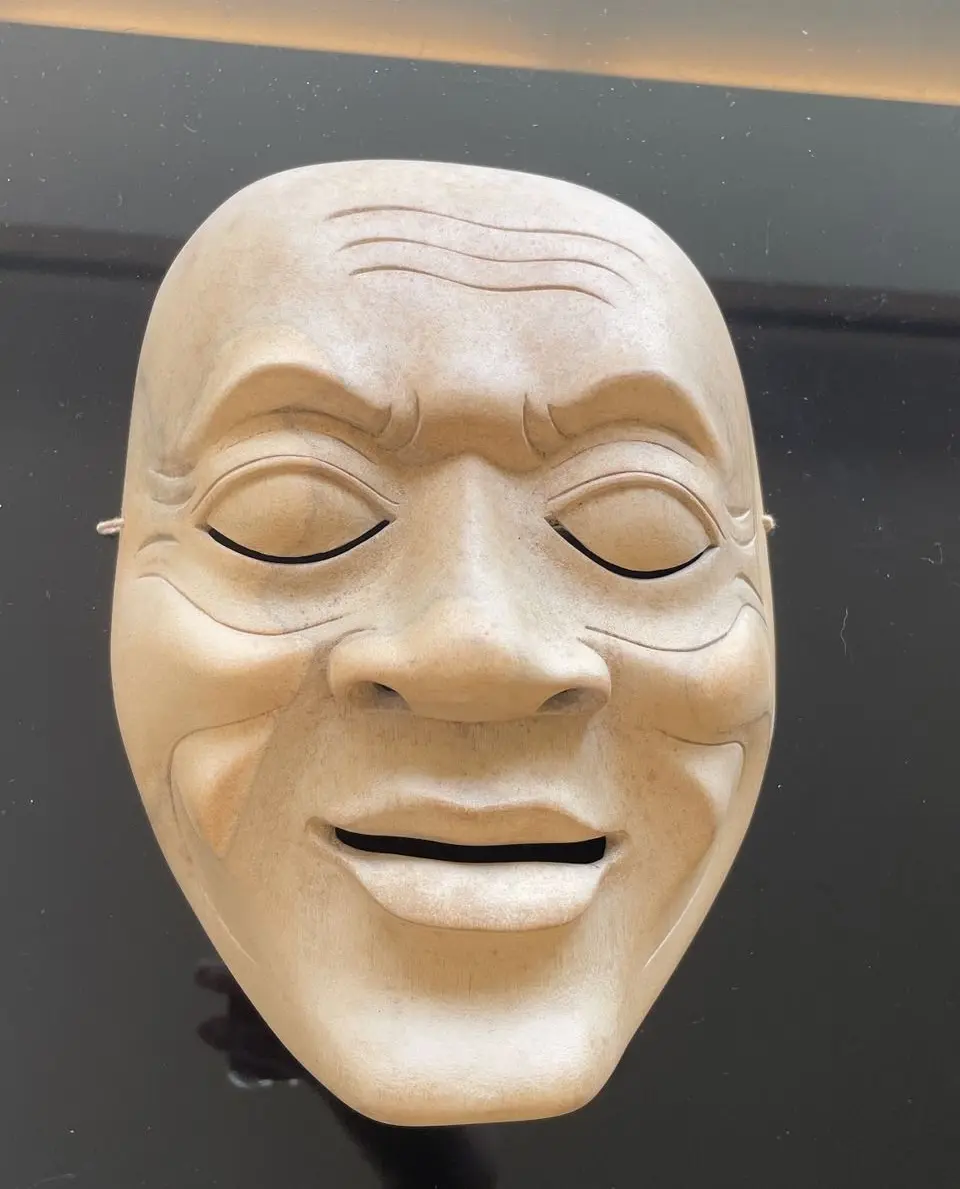
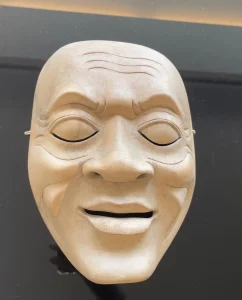 This mask portrays an elderly man marked by deep forehead wrinkles, heavy brows, pronounced laugh lines, and a strong chin, all carved into a single solid piece rather than using the movable jaw seen in certain ceremonial masks such as Okina. His slightly open mouth reveals teeth beneath a restrained, knowing smile that conveys calm wisdom rather than frailty. In the world of Noh theater, old man masks known as Jō-men rarely represent ordinary elders. They are often manifestations of hidden deities, spirits tied to sacred trees, or the ghosts of noble figures who first appear in human form to recount ancient stories before revealing their divine nature. The serene smile and deeply weathered features symbolize benevolence, spiritual depth, and an otherworldly peace acquired through age and experience. This archetype emerged during Japan’s Muromachi period in the fourteenth and fifteenth centuries, when renowned mask carvers developed distinct sub-types to give divine old men a more rugged and dignified appearance, setting them apart from the more delicate or aristocratic elderly characters seen elsewhere in the Noh tradition. The Mask is unpainted and not decorated yet. (Private Collection)
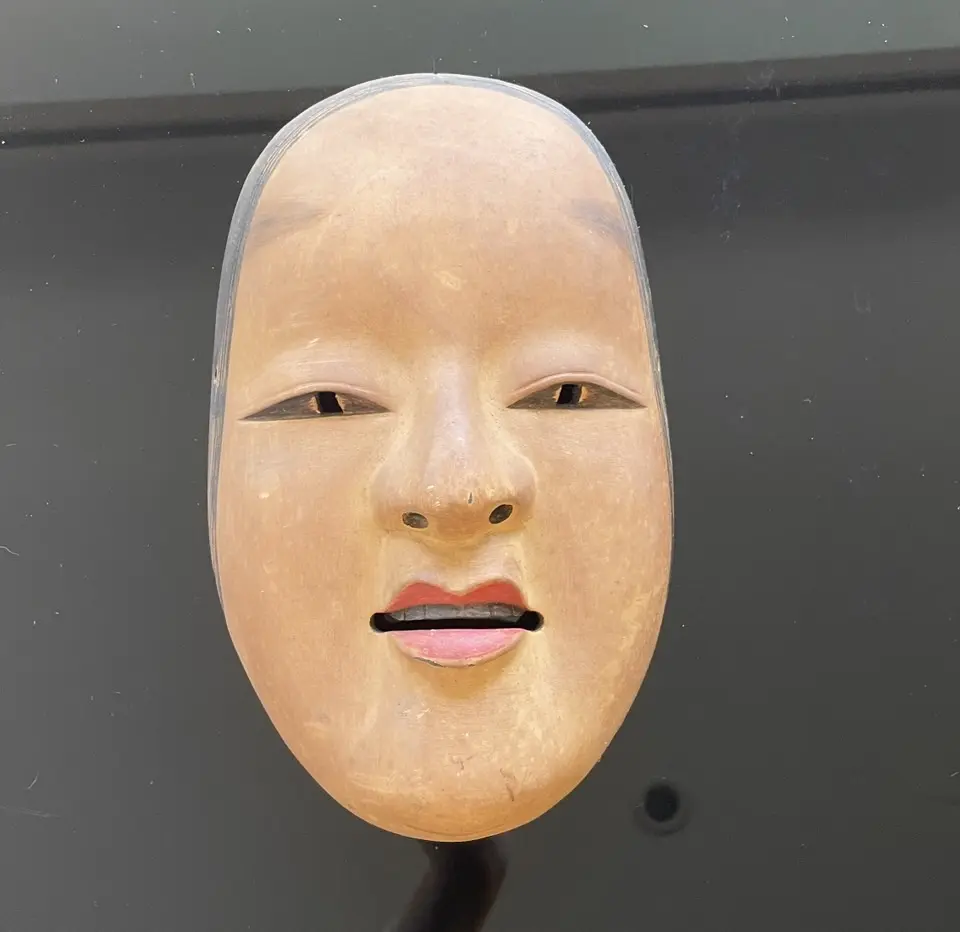
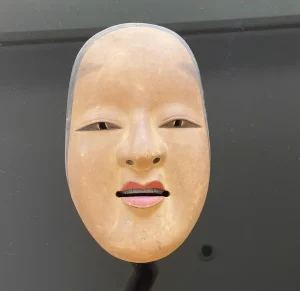 This mask portrays a youthful, serene face shaped by smooth features, narrow half-closed eyes, and delicately parted lips that create an expression balanced between quiet elegance and hidden melancholy (Ko-Omote). In Noh theater masks, masks of this kind are often used for noble women, spirits, or celestial beings whose beauty carries a sense of impermanence and emotional depth. Its restrained design reflects the classical Japanese aesthetic of yūgen, where subtlety and ambiguity are valued over dramatic expression, allowing light, movement, and shadow to transform the mask’s mood from calm grace to silent sorrow during performance. The refined proportions and understated realism connect this style to mask traditions developed during Japan’s Muromachi period, when master carvers perfected the art of creating emotionally ambiguous faces capable of expressing multiple states at once. Such masks became some of the most revered forms in Noh because they embody the fragile boundary between the human and spiritual worlds, where grace, memory, longing, and silence exist together within a single expression. (Private Collection)
Noh theater was developed by the actor and playwright Kan’ami and his son Zeami, who established its fundamental principles. The art form evolved from earlier rustic performances and religious rituals, blending elements of dance, music, and drama with influences from Shinto and Buddhist traditions. The masks were not mere props but were considered sacred objects, believed to channel spirits, deities, and otherworldly beings, transforming the performance into a spiritual act. This deep connection to ritual imbued the masks with a profound significance that persists to this day.
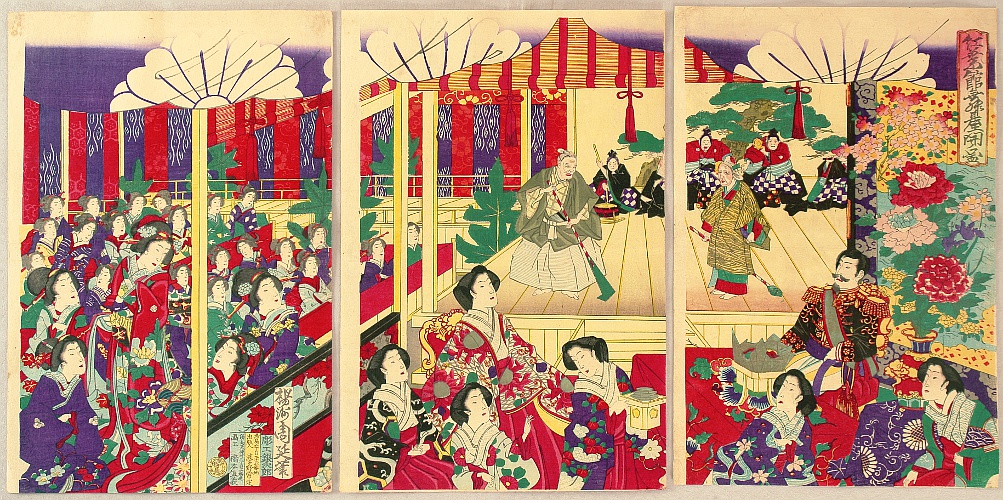
In the world of Noh theater, the mas; or *men*; is far more than a simple prop or disguise; it is the spiritual and dramatic nucleus of the performance itself. Unlike Western theater, where the mask often hides the actor’s face, the Noh mask is considered the vessel for the character’s soul, allowing the performer to transcend their own human identity and channel the essence of a deity, demon, ghost, or noble warrior.
The mask is crafted with extreme precision, often taking months to carve and paint, because the subtleties of its features; the angle of a lip, the depth of an eye slit, or the curvature of a cheek; determine the entire emotional spectrum of the role. Master actors rely on the mask’s fixed expression to convey complex, shifting emotions through the slightest tilt of their head or change in posture; a mask that appears to be smiling when viewed from above can suddenly look sorrowful or menacing when the actor lowers their chin. Furthermore, the act of putting on the mask is a sacred ritual, marking the moment the actor leaves their own persona behind and enters the realm of the character, a transformation that is treated with profound respect and silence.
Ultimately, Noh masks are not worn to hide the actor, but to reveal the invisible, giving tangible form to the fleeting, nuanced spirits of Japanese folklore and history.
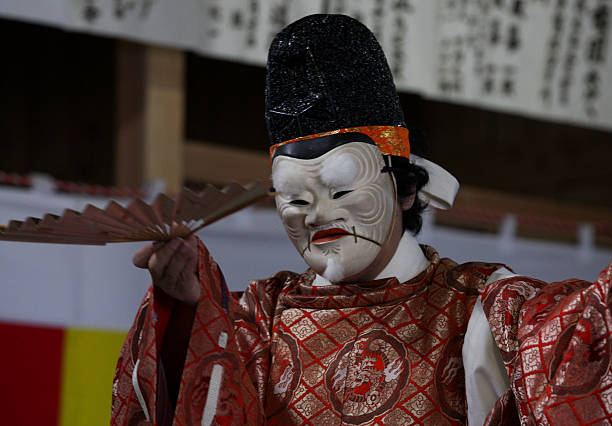
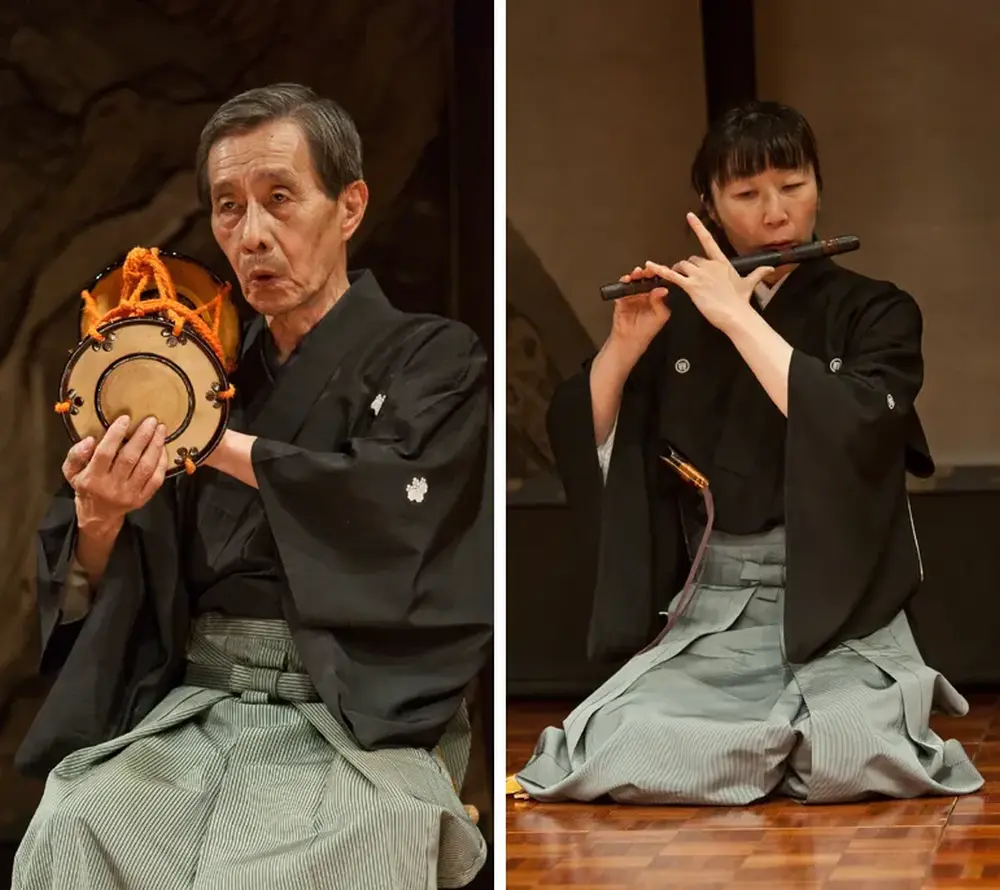
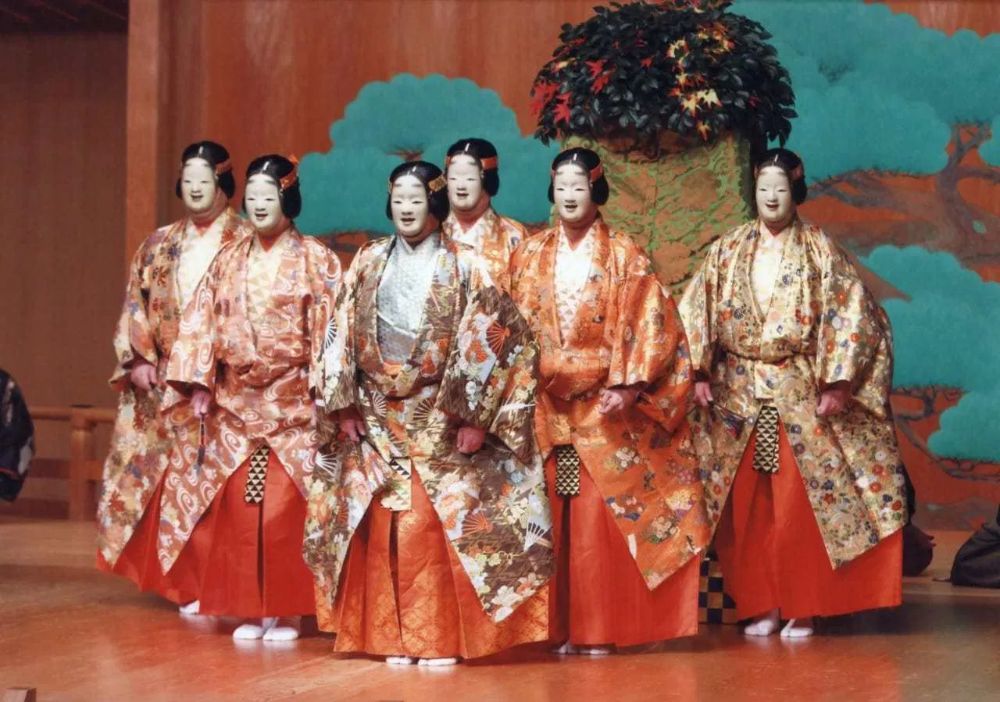
The visual impact of Noh is heightened by a precise choreography of presence. The main actor, or shite, stands as a vivid focal point of color and mask. Surrounding them are the musicians and the chorus, providing a visual and auditory “anchor” for the scene. These performers sit in a formal, disciplined posture at the side and rear of the stage, dressed in muted, traditional hakama that allow them to recede into the background of the viewer’s consciousness.
The multi-sensory experience is driven by the physicality of these musicians. One can see a performer holding a kotsuzumi (small hand drum) firmly to his shoulder, ready to strike, while another holds a fue (flute) to his lips. Their stillness and dark clothing contrast sharply with the shimmering silks of the masked figures. This arrangement ensures that the visual field remains uncluttered, forcing the audience’s gaze to concentrate intensely on the masked figure. Every gesture made by the shite carries immense narrative weight precisely because the surrounding ensemble is so disciplined in its austerity.
Noh theater remains a pinnacle of symbolic depth, proving that minimalism can be more evocative than spectacle. By stripping away the unnecessary and focusing on the interplay between carved wood, heavy silk, and a static backdrop, Noh achieves a level of intensity that modern theater rarely reaches. It is a reminder that the most profound stories are often told through the smallest shifts in light and shadow.
In a world of high-definition digital effects, what can we learn
from a piece of carved wood that has been telling human
stories for six hundred years?
Images : Private Collection (When explicitely mentioned), Web
Text : Scribblegeist (Ghost of the runaway pencil)